


Building Scalable Tele-Specialty Care for Rural and Underserved Communities
The Best Platform | The Access Gap | The Model | The Infrastructure | The Measures of Success
For many rural and underserved communities, access to specialty care is still defined by distance, workforce shortages, long wait times, and the availability of services outside the local community. Patients may travel hours for an appointment, wait months for a referral, or be transferred away from a hospital that could otherwise continue managing their care with timely specialist support.
As states implement the Rural Health Transformation Program, many are looking at hub-and-spoke telehealth models as a practical way to extend specialty expertise through rural hospitals, clinics, and community-based care settings. These models can make limited specialist capacity available across a broader region, but only when supported by infrastructure that connects organizations, care teams, data repositories, and workflows at scale.
While this model provides the technical and clinical solution for access to care, rural provider organizations typically don’t have the volume necessary for a given specialty to make the economics of the program work. That’s why the model offered as a shared services program is essential for program viability and sustainability in rural communities.
The implication of a shared services program is that many independent healthcare organizations, each with its own electronic health records (EHR) system, need to be serviced by the same remote specialists. Those disconnected systems are what leads to broken workflows and data access challenges that don’t exist when there is a singular EHR used by everyone.
What Is the Best Virtual Care Platform for Specialty Care?
The best virtual care platform for specialty care is one that can support a sustainable hub-and-spoke model across multiple sites, specialties, provider groups, and EHR environments. It should connect local care teams with remote specialists, coordinate referrals and consults, exchange relevant clinical information, and show whether patients are receiving specialty care sooner and closer to home.
The right platform is the one that can support the specific access gap a state or healthcare organization is trying to close and expand with the program without sacrificing efficiency or performance.
Start With the Specialty-Access Gap
A strong tele-specialty strategy begins by defining where patients are falling out of the care pathway today.
For one community, the immediate need may be behavioral or mental health coverage in rural emergency departments. For another, it may be faster access to neurology, cardiology, maternal-fetal medicine, oncology, or another high-demand specialty. A statewide network may need to coordinate several hubs and dozens of spoke sites, while a regional health system may be extending its existing specialists to a smaller group of partners.
Before selecting technology, healthcare leaders should be able to answer:
- Which patients and communities have the greatest unmet need?
- Which specialties have the longest wait times or highest referral leakage?
- Where are patients traveling or being transferred to for care?
- Which local clinicians need access to specialist support?
- What prevents an available specialist from reaching the patient today?
- What should improve if the model succeeds?
These questions keep infrastructure decisions tied to the mission of expanding access.
Build the Hub-and-Spoke Operating Model
In a hub-and-spoke model, a specialty hub extends expertise to hospitals, clinics, and other spoke sites across a region or state. Participating organizations can share limited specialist capacity rather than requiring every community to independently recruit and maintain the same services.
The model should define how a referral or consult enters the network, how urgency is determined, how the appropriate specialist is identified, how local and remote teams collaborate, where documentation is completed, and how recommendations and treatment plans return to the spoke site.
It should also be designed for growth. A workflow that functions for one specialty and three hospitals may not hold up when the network expands across several specialties, provider groups, and EHR environments.
Match Infrastructure to the Access Challenge
The most useful way to evaluate a specialty virtual care platform is to connect each access challenge to the infrastructure needed to address it and the measure that will show progress.
| Specialty-access challenge | Infrastructure requirement | KPI to track |
| Long wait times | Referral routing, scheduling, and prioritization | Time from referral to appointment |
| Unnecessary transfers | On-demand provider-to-provider consult queuing and routing | Avoided transfers |
| Referral leakage | Coordinated intake and results | Referral and consult completion |
| Fragmented care across EHRs | Clinical data and documentation exchange | Documentation and results completion |
| Limited local capacity | Hub coverage across multiple spoke sites | Number of consults per site |
| Inconsistent performance | Shared network analytics | Response time, utilization, and outcomes |
This framework keeps the technology conversation focused on the care-delivery problem rather than on capabilities in isolation.
Capabilities That Support Scalable Specialty Access
Specialty-Specific Workflows
Different specialties require different intake processes, urgency levels, escalation paths, clinical information, documentation, and treatment plans. The platform should allow workflows to be configured around each service line.
EHR and Clinical System Integration
Hub-and-spoke networks frequently connect organizations using different EHRs, scheduling platforms, imaging systems, and documentation workflows. The platform should exchange relevant patient information, facilitate submission of consult requests and appointment scheduling, provide for consult documentation, automate return of recommendations and treatment plans, while creating a consistent experience for remote consulting clinicians.
Provider Collaboration and Clinical Context
The platform should support consult requests, notifications, escalation, handoffs, and communication between local teams and remote specialists, including click-to-connect videoconferencing. It should also make the medical images, laboratory results, vital signs, device data, and prior documentation required by each specialty available within the workflow.
Multi-Site Scalability
States and health systems need infrastructure that can support additional hospitals, clinics, provider groups, and service lines without creating a separate technical environment for each one.
Analytics and Reporting
A shared reporting layer should provide visibility into access, utilization, timeliness, operational performance, and outcomes across individual sites and the broader network.
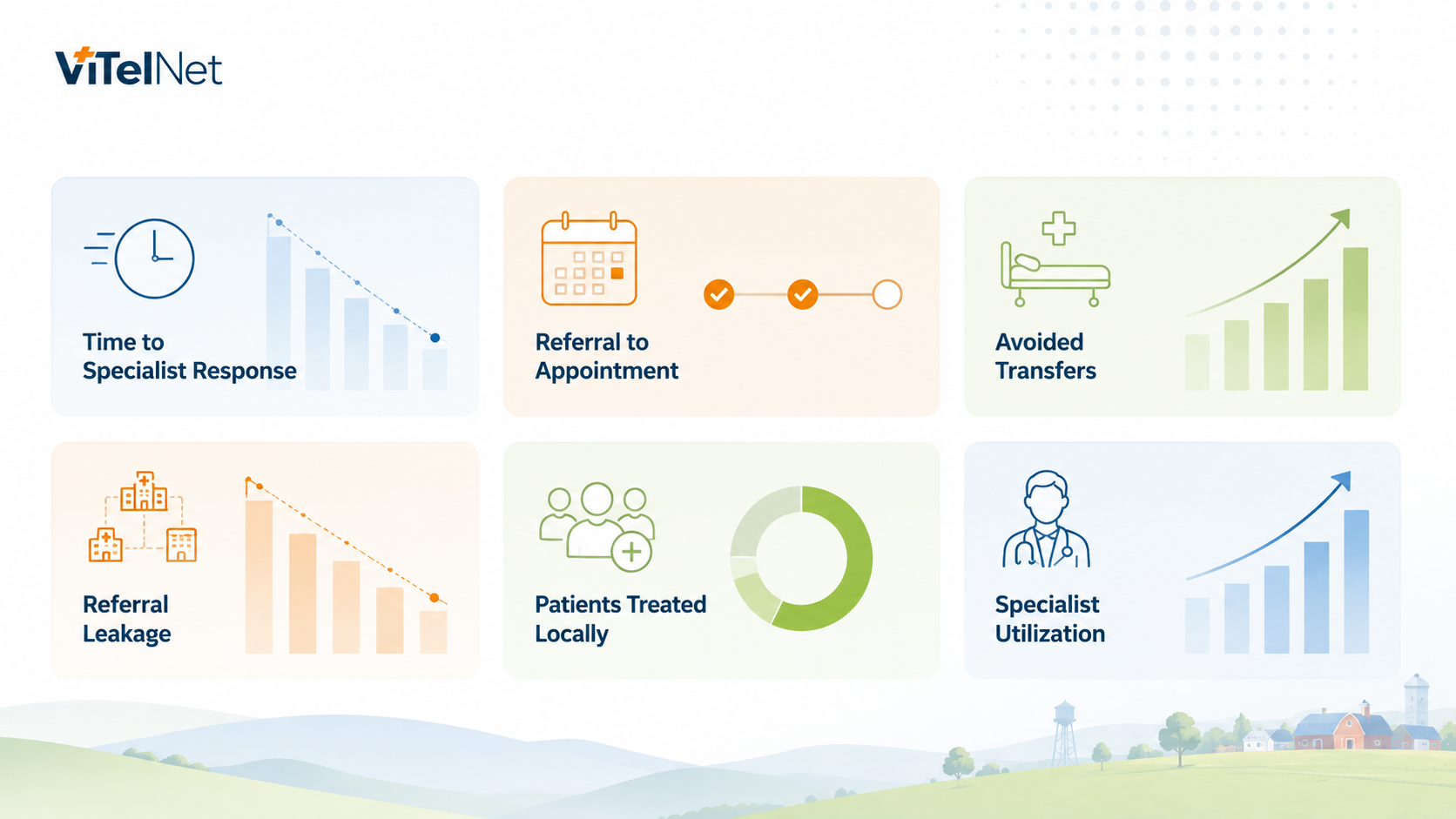
Measure Access, Not Just Activity
The number of completed encounters is useful, but it does not answer the most important question: Is the program reducing the time and distance between patients and specialty care?
A meaningful performance framework should include:
- Time from referral or consult request to specialist response
- Time from referral to completed encounter
- Specialty appointment wait times
- Referral and consult completion rates
- Referral leakage outside the network
- Avoided transfers
- Avoided emergency department visits or admissions
- Patients treated within their local communities
- Geographic reach and communities served
- Access among rural, underserved, and high-need populations
- Specialist availability and utilization
- Readmissions
- Provider and patient satisfaction
- Specialty-specific clinical outcomes
- Cost per consult and program sustainability
These KPIs can help states and health systems understand whether Rural Health Transformation investments are expanding access, strengthening local delivery capacity, and producing measurable improvements.
Keep Local Care Teams at the Center
The purpose of a hub-and-spoke model is not to replace rural hospitals, community clinics, or local providers. It is to give them stronger access to specialty expertise.
Local clinicians understand the patient, the community, and the resources available after the consultation ends. Remote specialists bring expertise that may not otherwise be available locally. A strong operating model keeps both teams connected throughout the care pathway.
That collaboration can help organizations manage more patients within their communities, reduce avoidable transfers, and prevent downstream revenue leakage for the rural hospital.
Plan for Sustainability From the Beginning
Rural transformation funding can help launch and expand new models, but long-term access depends on whether those models can continue beyond the initial implementation period.
Planning should address governance, specialist capacity, spoke-site staffing, credentialing, licensing, reimbursement, training, technical support, workflow adoption, and performance accountability. It should also establish how new specialties and sites will be added.
Sustainable infrastructure should make the network easier to expand and manage over time, not more fragmented with each new initiative.
What This Looks Like in Practice
At Vanderbilt University Medical Center, ViTel Net supported a centralized teleneurology workflow across eight partner sites. Service requests, specialist notifications, and documentation were coordinated across different EHR implementation approaches. The program improved time from service request to provider response by 30% while reducing manual phone-based coordination.
The example illustrates the broader requirement: specialty networks need a consistent way to connect clinicians, data, and workflows across organizations, understanding that every partner operates in their own technology environment.
Where ViTel Net Fits
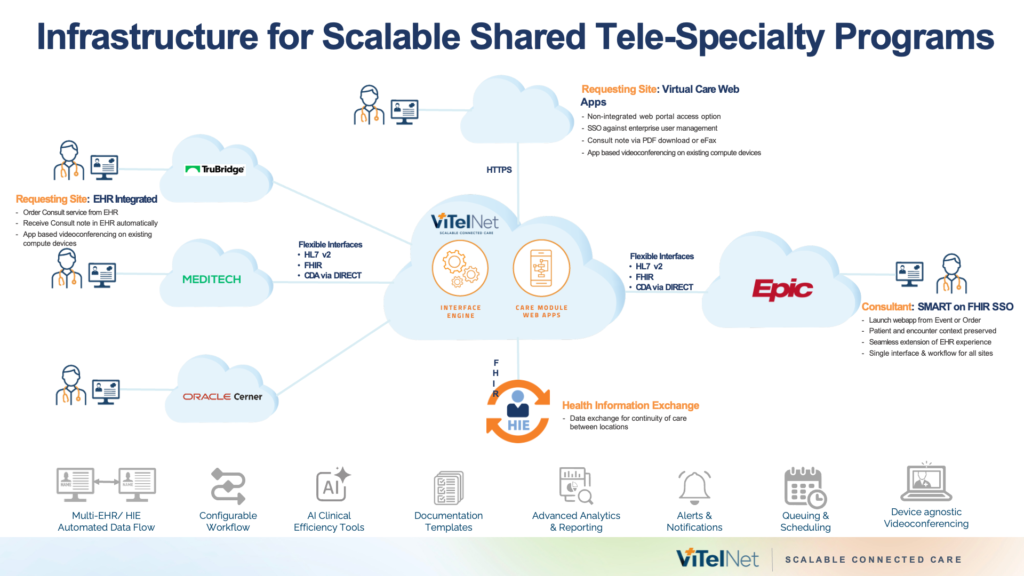
ViTel Net is an enterprise telehealth workflow and dataflow technology partner. Our vCareCommand platform helps healthcare organizations configure and scale virtual care workflows across specialties, sites, care teams, and clinical systems.
For states, health systems, rural hospitals, academic medical centers, and specialty groups developing hub-and-spoke networks, vCareCommand supports specialty-specific workflows, multi-EHR integration, provider collaboration, medical imaging, scheduling, and network-wide reporting.
The objective is to provide the connected infrastructure around the consult so organizations can optimize efficiency, measure impact, and expand access to additional sites, specialties, and communities.
Closing the Specialty-Care Gap
The best virtual care platform for specialty care is the one that helps translate an access mission into a workable, scalable, and sustainable care model.
It should help patients reach specialists sooner, keep local clinicians central to the care pathway, connect organizations operating in different technology environments, and give leaders the data needed to understand where access is improving and where gaps remain.
For states and health systems investing in rural transformation, the opportunity is to build lasting infrastructure that makes a patient’s location less determinative of whether they can receive the specialty expertise they need.
Frequently Asked Questions
How does a hub-and-spoke tele-specialty care model work?
A central specialty hub provides expertise to hospitals, clinics, and other spoke sites within a regional or statewide network. The model helps patients receive more care locally while giving community-based clinicians access to specialists, shared workflows, and coordinated follow-up.
What KPIs show whether tele-specialty care is improving access?
Important measures include referral-to-consult time, specialty wait times, consult completion, avoided transfers, referral leakage, follow-up completion, patients treated locally, geographic reach, specialist utilization, and specialty-specific outcomes.
What should states prioritize when building tele-specialty infrastructure?
States should prioritize infrastructure that can support multiple specialties and participating organizations, integrate across EHR environments, coordinate referrals and consults, support local care teams, and provide network-wide performance reporting.
Can one virtual care platform support multiple specialties?
Yes, when the platform supports configurable workflows. Each specialty may require different intake, escalation, documentation, clinical data, and follow-up processes.